

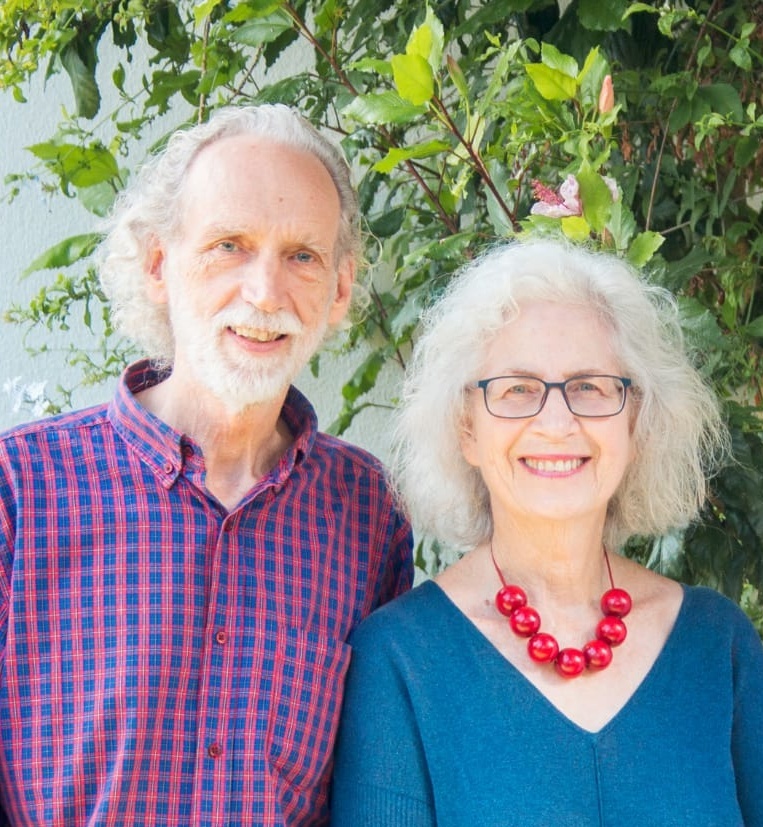
Rev. Ab IJzerman and his wife, Trix
On Sunday morning 27 November, after 25 years of ministering at URCSA Khayelitsha, the congregation bid their beloved minister Rev. Ab IJzerman and his wife Trix farewell.
Growing up, studies and calling
Rev. IJzerman was born in Heerde, the Netherlands and grew up there as well. “My parents were deeply religious people, but they were poor and lived very simply,” says Rev. IJzerman. “Fortunately, the Dutch government at that time paid for everyone’s studies in full and I was able to study after completing my secondary school qualification and obtain a degree in mechanical engineering.”
“I experienced the Lord calling me to the ministry when I was only ten years old, but I was afraid and shy and always shied away from it until I was 30 years old. There was no one who had an influence on this decision. On the contrary, it would not have been well received in that static rural farming environment, because ministers came from the city.
“After my studies, I went to work at Canzibe Hospital in the former Transkei in 1982 and tried live my calling there in a more practical way. First I managed the maintenance of the hospital for a number of years and thereafter I initiated a job creation project at Mfesane. It was a very good preparation for my ministry in Khayelitsha. At that time I began to become aware of the church’s responsibility regarding the socio-economic development of people.
“In 1988 I married Trix van Zyl and I began my theological studies – first in Port Elizabeth and then at Stellenbosch. In 1996 I finished with a MTh in Missionary Science under the guidance of Prof. Martin Pauw. During the study period I also worked for a year at the Peace Committee in Stellenbosch in 1994 with, among other things, the monitoring of the election which later turned into a project working with gang members. Although I am a systematic theologian at heart, I was largely influenced by the theology of David Bosch because it was credible and relevant to me at that time. The questions of credibility, human dignity, social justice and relevance were formed in me during that time.”
Calling to URCSA Khayelitsha
“When I was called to URCSA Khayelitsha in 1997, I asked for a postponement of the decision three times, because I felt that the time of white missionaries and paternalism was over. What should my role be? For me it would possibly be a symbol of reconciliation (as expressed in the Confession of Belhar), that background differences do not matter in the Kingdom and that we could interact with each other as equals. I further thought that the great challenge in my ministry was to help lead the church to independence and to be a credible witness in the area. Khayelitsha was separated from URCSA Nyanga congregation just a year ago and with the support of the then Peninsula Council and Masibambane was able to call their first minister and was therefore totally financially dependent of the DRC. The church council, with no trained people, was completely dependent on the leadership of the minister. This had to be broken.
“There was also an expectation from DRC ranks that all kinds of projects would have to be initiated in Khayelitsha. This against the background of missionary thinking in the DRC at a time when charity, rather than justice, was important. My hope was that the church in Khayelitsha would first have to become independent with a sense of self-worth and a Kingdom perspective and from there start with projects that are initiated and operated by themselves. However, so far this has not happened yet.
“The highlights of my ministry are that the congregation grew a lot through the congregation members’ own work, and furthermore that, when the financial support from the DRC began to wane, the congregation was able to pay my salary from its own funds on scale. Then, from own funds, a new church building was built in one of the wards and they also had the existing church building enlarged. A few years ago they also gave us a new car as a sign of appreciation after 20 years of service in the congregation.
“It is also gratifying to see that there are now more younger and educated people serving on the church council who can attend to the administration and develop the congregation further. This is largely thanks to the new dispensation after 1994 through which many young people could receive better training and could obtain better work. It is actually a completely new kind of congregation that has arisen.”
Challenges
“However, Covid-19 was a major financial crisis for the congregation. Members contribute financially to the congregation as they are involved. When there were no more meetings for a long time, the contributions also dried up. Furthermore, many people lost their jobs and members on the fringes of the congregation disappeared. Furthermore, after being my co-teacher for six years Rev. Siyabulela Potwana left for this reason. Many things now need to be rebuilt from scratch.
“South Africa is a country of stark contrasts between rich and poor. This becomes extra clear when there are foreign visitors who perceive the differences much more sharply and ask me painful questions. For me, the question is: ‘Who is really poor? When I experience the richness of community, sincere trust in God, the love and respect of people and exuberant joy in the church services and I compare it to my background in the Netherlands, I always ask again: ‘Who is really rich?’ If more people could experience something like this, it would probably go much better with church unity and also in general in the country. I came to give and teach other people, but I only received and learned from them and in the process became much more humble.
“In 1988 I got glandular fever which then permanently turned into CFS (Chronic Fatigue Syndrome, also known as yuppie flu). The pain and fatigue from this, limited the rest of my life a lot and I couldn’t do everything I would have liked to do. At the same time it allowed me to stay in Khayelitsha. In 2015 I was declared medically unfit, but remained as a minister in the congregation and supported my colleague.”
Climate Change Coordinator
“From 2006 to 2007, I also worked part-time for the interfaith environmental organization SAFCEI as climate change coordinator. This was to help make ends meet. At the same time, I also realized that the Kingdom is wider than just the church. At that time few people had heard of climate change. It was very enriching for me to be involved with the matter of ecology or the environment and to understand its urgency. It also forced me to have respect for people from other religions and to realize that if God can use me (and Balaam’s donkey too!), then He can also work through other religions.”
Rev. IJzerman’s dream for the church and in particular for Khayelitsha
“My wish for the church in general is that the church will feel at home in Africa with all its challenges and possibilities. This will also promote church unity. As long as a part of the church tries to still be from Europe or America, there will not be much progress. It all depends on the connotations that people attach to ‘Africa’. As long as one only thinks of Africa as backward, irrational and chaotic, there will be no unity in this country and the church. The key lies in exposure to each other’s lives and moving closer to Jesus Christ Himself.
“My wish for Khayelitsha in particular is that young people will be guided in this time in which we live. Life is now so much different from that of their parents. The church is still very much stuck in its traditions, and authority structures try to limit young people. On the other hand there is modern life with prosperity and individual freedom and everything we see on TV. Then there are also the churches that come with promises of material prosperity, but ask a lot to be paid. All these forces attract our young people. Many young people do not find work and become desperate. Why then does God not hear them? In general, they are confused and without direction. What the church offers at this stage is a community and security and furthermore the hope of God’s promises for this life. However, it is all still very self-oriented and little oriented towards others and towards what the faith means for this world and for this country.”
So what enriches and helps to shape Rev. IJzerman’s insights?
“Unfortunately, due to my poor health, I don’t get much chance to read. I am quite influenced by the Dutch theologian, Bram van de Beek, who is trying to design a radical prophetic and Christ-centered theology for the Netherlands. The other books that I read and that helps me with new insights is everything that often lies on the edge of theology. A lot of theology these days is about how to experience God more or to let the church grow or to make the faith and the church acceptable for modern man and to be relevant. Furthermore, I also like to read ‘classical theology’ again and realize its richness.
“For me, it is important to be busy with the questions that Africa, ecology and science impose on us and how they especially affect young people. As far as Africa is concerned, I am interested in African theology, Liberation theology and what the religious experience of ordinary people is in places like Khayelitsha. The challenges of modern science are the kind of questions that people like Ben du Toit put on the table, but also the challenge of information technology and social media that may result in a society without values and without individual freedom. Fortunately, ecology and climate change is a theme that is receiving attention these days. However, we still struggle to grasp the seriousness of this crisis and how to relate it to the core of our faith.
“All these questions find their focus in the question of what it means to be a true disciple of Jesus Christ at this time – in Khayelitsha, in Africa, in the whole world and in creation/nature.”
Rev. IJzerman’s family
“I have been happily married to Trix for 34 years. She used to be a primary school teacher, also traveled for the CSV (Christian Student Association) and was involved in Industrial Ministry in Port Elizabeth. She faithfully supported me all these years of study and parish ministry. She has also played a huge role in the congregation. ‘Alikho khaya umana eksho’ – there is no house (or congregation) without a mother. We have two children and two grandchildren who bring us great joy.”
In conclusion
“The path that my life has taken (and especially in Khayelitsha), is not one that I antisipated for myself or chose, but my life has been infinitely enriched by it and I am very grateful to the Lord for that.”