
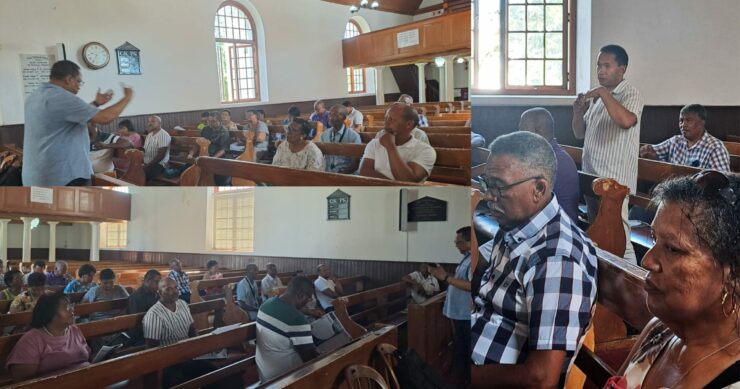
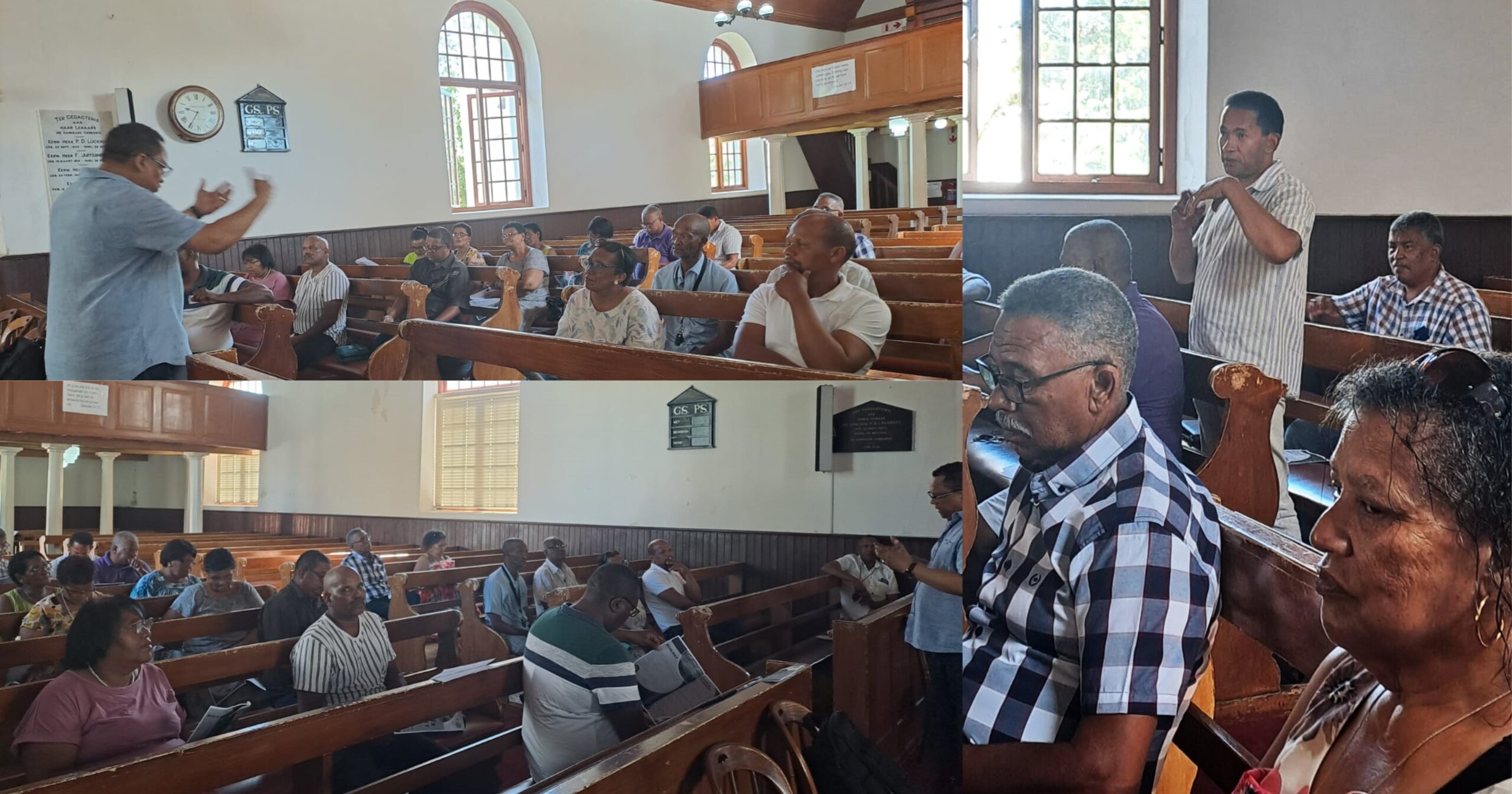
Rev. Pedro facilitating the information session at Stellenbosch.
“The session was very meaningful and informative,” says Rev. Willie Koopstad from URCSA Idas Valley, “it helped us to reflect on our missional calling. It was also good to hear about the resources that are available to us. I liked the interactive way Rev. Pedro engaged with us. The session gave me so much energy and clarity about our mission.”
Rev. Desmond Meyer from URCSA Koelenhof says: “It was a very positive experience for me and my church council members. They especially enjoyed the Dwelling in the Word session. The interaction with other attendees was great and we received a lot of information. It was an enriching experience. One of my council members said that it was an interesting experience for him and that he learned how to do follow-ups in our congregation.”
“The fact that everything must start at yourself, was important to understand,” says elder Selina Fredericks of URCSA Simondium. “The importance of the role our congregations must play in our communities was emphasized. Now I have a much clearer understanding of the importance that our congregations have to become much more involved, supportive and visible in our communities. We also have to supports our proponents much more.”
_________________________________________
“An informed church is a growing and flourishing church.” This is what Rev. Stephen Pedro, minister in synodical services (MSS) and manager of the task team Congregational Witness firmly believes.
On 11th February Rev. Pedro facilitated an information session with URCSA Cape Regional Synod’s Presbytery of Stellenbosch at URCSA Rhenish Congregation. Thanks to the groundwork that has been done in advance, the session was attended by all nine congregations, namely Kylemore, Franschhoek, Idas Valley, Stellenbosch (Cloetesville), Vlottenburg, Rhenish, Simondium, Koelenhof, and Kayamandi. Altogether 20 representatives attended the information session.
“The main goal of our mission is to place service and witness in the centre of the ministry of congregations. Our mission, as such, is to journey beside congregations to adapt to a culture of being a missional church,” explains Rev. Pedro.
“The outcome of this information session at Stellenbosch was the result of a process that started in late 2022 when the idea arises from my reflection on the past year, to have information sessions with a few presbyteries apart from my accompaniment and support work with congregations and presbyteries,” says Rev. Pedro.
“The second reason was because in my contact with members I regularly get the question, ‘So what are you really doing?’ But also, because one realizes the importance of sharing information of the services that are available to our congregations. I think it is indeed so that an informed church is a growing and flourishing church.”
The Information Session
The session was kicked off at 09:00 with a Dwelling in the Word session. “We read together from the Revised Common Lectionary from the gospel reading of the day, Matthew 15: 1–9,” says Rev. Pedro. “Here again I experienced that it really matters how we gather. Dwelling in the Word is not only the right way to start any gathering of the church, but it also sets the tone for the gathering.”
After the Dwelling in the Word Rev. Pedro continued the session by categorising the information into two parts: the work Witness Ministry is doing on behalf of the church and its congregations, and the work they do with and in support of congregations.
With regards to the work we do on behalf of our congregations we shared information about the work of the six task teams of Witness Ministry, namely Congregational Witness, Public Witness, Ecumenical Partnerships in Africa, Industrial Ministry and of the two new task teams, Ecology and Evangelisation.
A booklet with a summary of the work of the six task teams that we developed after our Eastern Cape conferences last year was also shared with the attendees to take back and also for their reports to the church councils.
A few pointers that resulted from this discussion were the following:
• that the presbytery needs to reflect on their responsibility of being co–stewards of the work of Witness Ministry of the church, by looking into its contribution to this part of the ministry of our church family.
• the importance of the presbytery getting involved in outreach ministries and what it can mean for the presbytery and its congregations.
• that the presbytery needs to make more of its responsibility to focus on ecology, and really empower the congregations regarding this challenge that already, and in the future, will even affect us all more and more.
During the part about the work Witness Ministry does with and in support of congregations, Rev. Pedro focused on the work of Congregational Witness in support of the “vacant” congregations of URCSA Cape.
The session was closed with an overview of the accompaniment process with congregations. Rev. Pedro says: “It was stressed that the main goal of the accompaniment process is to empower and enable congregational leaders to manage and facilitate the process of change with their congregations. Furthermore, that the process of changing congregational culture can be a long, messy and draining process, and that the leaders must be committed and have a teachable spirit.
“Overall, it was good to connect with the leaders of our congregations in this way, and we hope to follow up on this with a few workshops with the presbytery on short–term outreaches, ecology and leadership development,” says Rev. Pedro.
Contact Rev. Pedro at stephen@kaapkerk.co.za for more information.